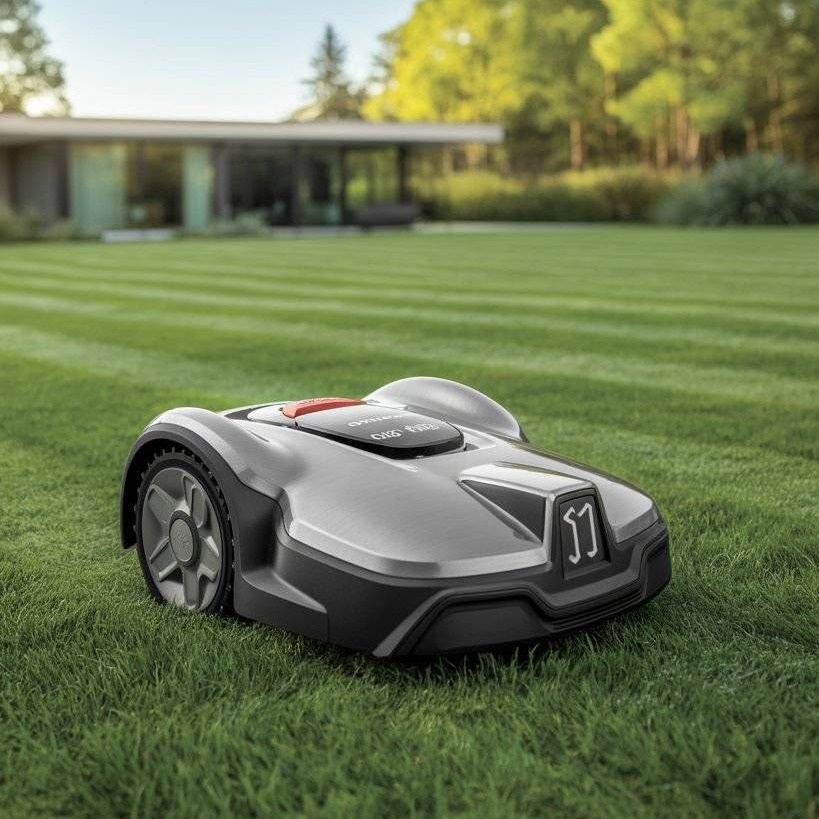
A robotic lawn mower is more than a small battery-powered mower that drives around by itself. It is a compact autonomous machine that combines electric drive motors, a cutting system, sensors, positioning technology, onboard control software and automatic charging into one mowing system.
Instead of waiting for the grass to become long and then removing a large amount of material in one pass, a robotic mower is designed around a different philosophy: cut frequently, remove very little at a time, and return to charge before continuing its programmed work.
That difference is fundamental to understanding how robotic mowing works.
Newer systems can use satellite positioning and virtual boundaries, while advanced models may combine positioning with cameras, radar or other sensors to recognize obstacles and improve navigation. The result is a mower that can operate with considerably less human intervention than a conventional walk-behind or riding mower.
But not every robotic mower is suitable for every lawn.
The best robot mower for a small residential yard may be completely different from the right machine for a large estate, hotel, commercial property, sports field or professional landscaping operation. Lawn size, terrain, slopes, narrow passages, obstacles, edge conditions, navigation technology and charging requirements all matter.
A robotic lawn mower is an autonomous electric mower designed to maintain a defined grass area with minimal manual operation.
The basic system contains several major components:
. Electric drive motors
. Rechargeable battery
. Cutting motor and cutting deck
. Wheels and traction system
. Navigation and control electronics
. Boundary or positioning system
. Obstacle and safety sensors
. Charging system
. Software for scheduling and operating the machine
The mower leaves its charging station according to a programmed schedule, cuts the grass, monitors its position and surroundings, and returns to the station when its battery needs charging. After charging, it can resume mowing according to its programmed operating plan.
This creates an important distinction between robotic mowing and conventional mowing. A conventional mower is generally designed to complete the job in a relatively small number of passes. A robotic mower is designed to become part of the lawn's ongoing maintenance cycle.
The machine may therefore appear to be working slowly, but that is intentional. It is continuously maintaining the grass rather than waiting for the lawn to become heavily overgrown.
→ Explore Available Products
At the simplest level, a robotic mower follows a repeating control cycle:
Determine where it is → determine where it can travel → drive → cut → monitor the environment → manage battery power → return to charge → resume mowing.
The engineering behind that cycle is more interesting than it first appears.
1. The mower establishes its working area
Before the mower can operate autonomously, it needs to know where it is allowed to travel.
Traditional robotic systems use a perimeter or boundary wire. The wire is installed around the mowing area and around areas the machine must avoid, such as flower beds, ponds or other protected zones.
The mower detects the electrical signal associated with the boundary and uses it as a virtual wall. When it approaches the boundary, its control system changes direction rather than crossing it.
Modern wire-free systems use another approach. Satellite positioning technology can allow the operator to define virtual boundaries digitally. Instead of physically installing a wire around every section of the lawn, the mower calculates its position relative to the defined digital work area.
This is particularly useful when the lawn changes regularly or contains multiple mowing zones.
2. The control system decides where to travel
Once the working area has been established, the mower needs a movement strategy.
Older and simpler robotic mowers often use irregular or randomized movement. That does not mean the mower is operating without control. The machine constantly reacts to its boundary, obstacles and navigation signals while gradually covering the mowing area.
More advanced systems can use mapped areas and systematic mowing patterns. Instead of simply wandering through the lawn, the mower can travel in organized lines or selectable patterns.
This distinction becomes especially important on large commercial properties because systematic mowing can make better use of available operating time and create a more predictable cutting pattern.
3. Electric drive motors control movement
Most robotic mowers use electrically driven wheels rather than a conventional gasoline engine and mechanical transmission.
The control electronics can independently regulate wheel movement, allowing the mower to change direction without a steering wheel or human operator.
When the mower needs to turn, the control system changes the speed or direction of the drive wheels. On some machines, this creates very tight turning behavior because the left and right sides can be controlled independently.
The advantage is precise low-speed control with relatively few mechanical components between the battery and wheels.
4. The cutting system removes small amounts of grass
This is one of the biggest differences between robotic and conventional mowing.
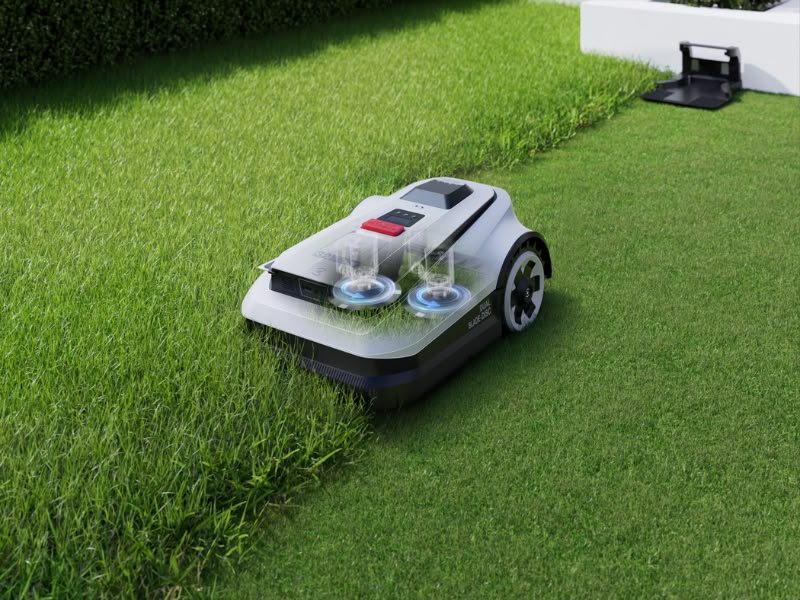
A robotic mower typically cuts only a small amount of grass during each mowing session. The cutting deck uses rotating blades or small pivoting blades attached to a cutting disc.
Because the mower returns frequently, it does not need to remove several inches of grass at once.
The small clippings are distributed back into the lawn where they can break down naturally. This approach is often described as mulching or micro-mulching.
The engineering reason is simple: the cutting system is not being asked to perform the same job as a large riding mower deck. It is maintaining the existing grass height continuously.
Robotic mower cutting system showing the compact rotating blade assembly used to make frequent, fine cuts.
Navigation technology is one of the most important differences between robotic mower generations.
Boundary-wire navigation
A traditional robotic mower uses a perimeter wire to establish the mowing area.
The advantage is that the boundary is physically defined and does not depend on satellite visibility. It can work well for conventional residential lawns when the installation is correctly planned.
The disadvantage is installation. The wire must be positioned around the perimeter and around exclusion zones. If landscaping changes, the wire may need to be moved.
GPS-assisted navigation
Some robotic mowers use satellite positioning to help determine their location.
GPS by itself is not automatically equivalent to highly precise autonomous navigation. Satellite positioning can have limitations depending on the environment, especially around buildings, trees and other obstructions.
This is where higher-precision positioning systems become important.
RTK-GNSS and virtual boundaries
Advanced robotic mowing systems can use Real-Time Kinematic, commonly called RTK, to improve positioning precision.
The basic principle is that the mower receives satellite positioning information and correction data that allows the system to calculate its position much more precisely than ordinary standalone satellite navigation.
This can support virtual boundaries and defined mowing zones.
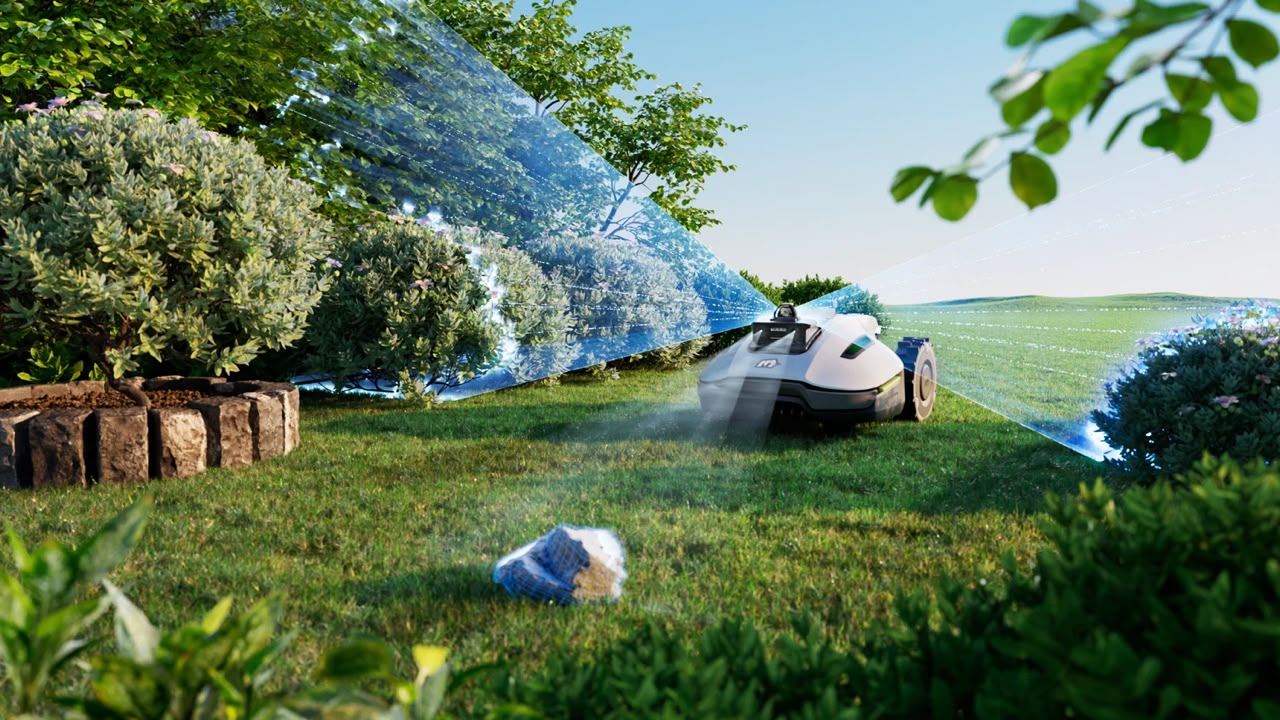
Virtual boundary and precision-navigation concept showing how satellite positioning can define robotic mowing areas without relying entirely on physical perimeter wire.
Obstacle detection is another area where robotic mower technology has evolved.
A simple system may rely heavily on physical collision detection. If the mower contacts an unexpected object, sensors detect the change in movement or physical contact and the mower stops or changes direction.
More advanced machines can use additional sensing technologies.
Depending on the mower, these may include:
. Bump or collision sensors
. Lift sensors
. Tilt sensors
. Ultrasonic sensors
. Cameras
. Radar
. Other proximity sensors
The objective is not simply to “see” an object. The mower has to interpret the sensor information quickly enough to decide whether it should slow down, stop, reverse or change direction.
That is a control-system problem.
The sensors provide information. The onboard controller interprets that information. The drive system then executes the response.
This is why robotic mowing is better understood as a small autonomous vehicle rather than simply a cordless mower with wheels.
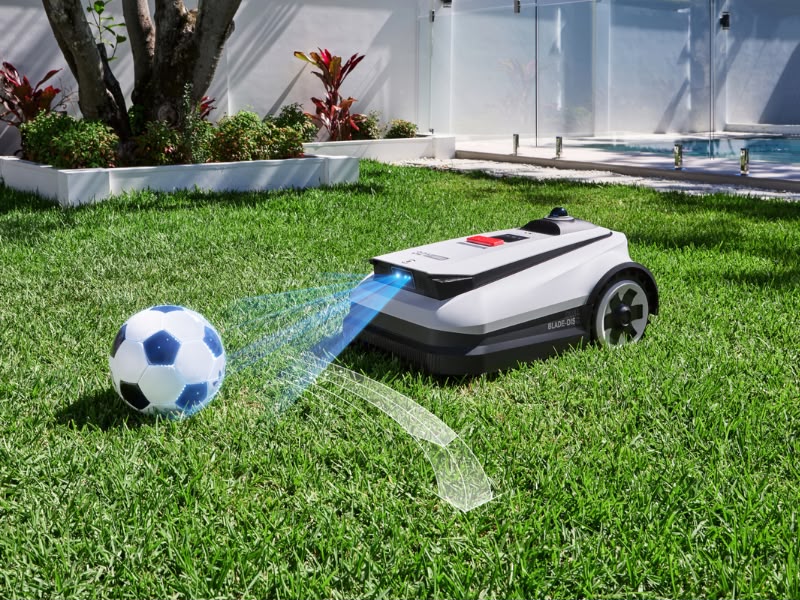
Obstacle detection in operation: the robotic mower identifies an object in its mowing path and can alter its movement rather than continuing directly toward it.
Autonomous operation requires multiple layers of protection.
A robotic mower can encounter people, pets, garden furniture and unexpected objects. For this reason, manufacturers incorporate safety mechanisms that can stop the cutting system or the entire machine under certain conditions.
Lift and tilt detection are particularly important.
If the mower is lifted from the ground or placed into a position where the cutting mechanism could become hazardous, the system can stop the blades.
Robotic mower safety should therefore be considered as a combination of:
detection + control logic + mechanical response + blade shutdown.
No sensor system should be treated as a substitute for sensible lawn management. Children, pets and people should still be kept away from active mowing equipment, and objects that could interfere with the machine should be removed before operation.
Slope performance depends heavily on the mower's design.
The important factors include:
. Motor torque
. Wheel diameter
. Tire tread
. Weight distribution
. Center of gravity
. Traction
. Surface condition
. Slope angle
. Direction of travel
. Grass and soil conditions
A mower can have enough motor power to climb a slope but still struggle if its wheels cannot generate enough traction.
This is why manufacturers publish maximum slope specifications, and why those numbers should not be interpreted as a guarantee that every terrain condition will produce identical results.
Wet grass, loose soil and uneven surfaces can reduce traction.
AWD robotic mowers are designed for more demanding terrain because torque can be delivered to more wheels, helping the machine maintain traction on difficult slopes.
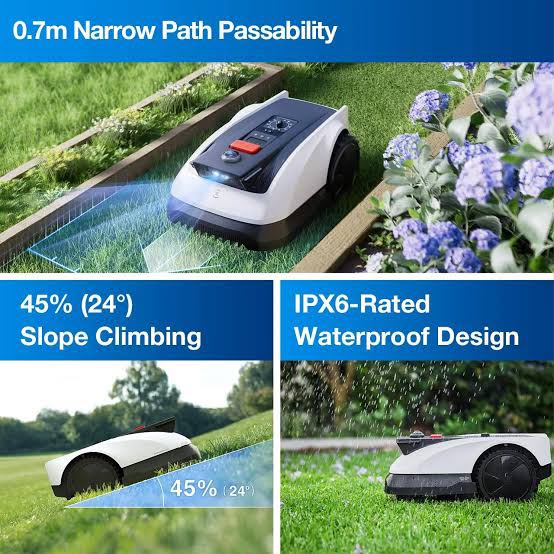
Robotic mower designed for demanding terrain, illustrating narrow-passage access, slope capability and weather-resistant construction.
A lawn may look simple from above but become complicated from the mower's perspective.
A garden can contain:
. Narrow corridors
. Trees
. Flower beds
. Separate lawn sections
. Walkways
. Slopes
. Fences
. Garden furniture
. Small entrances between mowing areas
A mower's ability to reach these areas depends on more than its advertised lawn capacity.
Its physical width matters. Navigation capability matters. The boundary installation matters. Turning space matters.
A machine that is technically rated for a large lawn may therefore be a poor choice for a property divided into several narrow sections.
When evaluating a robotic mower, always consider the shape of the lawn, not just its total area.
Robotic mowers are designed differently from conventional gasoline equipment.
The electronics, battery compartment and motors must be protected from moisture and contamination while still allowing the machine to operate outdoors.
Weather resistance is therefore expressed through the mower's enclosure and its ingress-protection rating.
However, weather resistance does not mean the machine can be treated as waterproof in every circumstance.
Cleaning instructions, storage requirements and the manufacturer's operating conditions should always be followed.
Rain also affects the lawn itself.
Wet grass can change traction and cutting conditions. On some lawns, repeated mowing while the soil is saturated can contribute to surface damage or wheel marks.
A sophisticated mowing schedule therefore needs to consider not only whether the machine can technically operate in wet conditions, but whether operating at that time is beneficial for the lawn.
Edge mowing is one of the most misunderstood parts of robotic mowing.
A robotic mower can get very close to some lawn boundaries, but the actual result depends on the edge design and cutting-disc position.
There is a major difference between:
. A grass edge next to a flat surface
. A grass edge next to a vertical wall
. A raised garden border
. A narrow drainage channel
. A decorative stone edge
If the cutting blades cannot physically extend over the edge, a small strip of grass may remain.
Advanced edge-cutting designs reduce this effect by positioning the cutting system closer to the side of the machine.
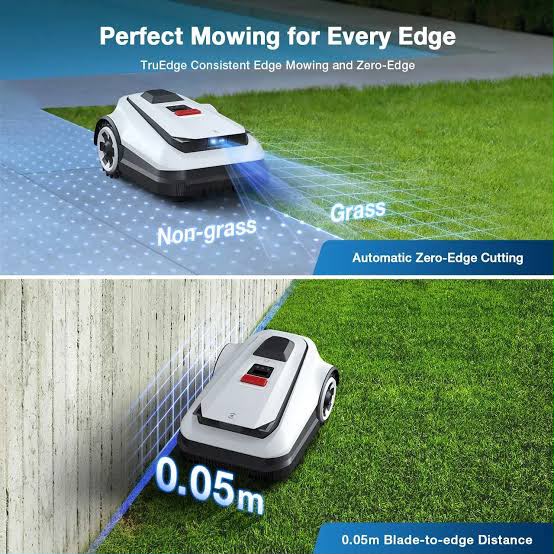
Close-edge cutting design showing how blade placement can reduce the uncut strip along lawn boundaries with precision.
Yes—but the answer depends on what you expect from one.
Robotic mowers are particularly effective when the objective is consistent lawn maintenance with minimal daily labor.
They are less attractive when a property requires heavy cutting of severely overgrown grass, frequent landscaping changes, extensive rough terrain or tasks beyond lawn maintenance.
Their greatest strength is consistency.
Instead of allowing grass to become long and then removing a large amount of material, the mower repeatedly makes small cuts.
This can produce a very consistent lawn appearance when the mower is correctly sized, installed and scheduled.
The technology is also quiet compared with many gasoline-powered alternatives, making it practical for operating during periods when conventional mowing would be disruptive.
The value proposition depends on what your time and labor are worth.
For a homeowner, the biggest benefit may simply be not having to spend hours pushing or riding a mower every week.
For a commercial operator, the calculation becomes more complicated.
A commercial robotic mower can potentially reduce the amount of repetitive mowing labor required for suitable turf areas, allowing personnel to concentrate on trimming, landscaping, maintenance and other higher-value tasks.
However, the purchase price is only one part of the calculation.
Consider:
. Initial mower cost
. Installation
. Boundary-wire or positioning infrastructure
. Batteries
. Blade replacement
. Cleaning and maintenance
. Connectivity requirements
. Software or fleet-management services
. Electricity
. Labor savings
. Expected operating life
The correct question is therefore not simply “How much does a robot mower cost?”
It is:
“What will this mowing system cost to own and operate over the period I expect to use it?”
Robotic mower prices vary considerably because the machines are not all built for the same workload.
Entry-level residential machines are designed for relatively small lawns and straightforward layouts.
Mid-range machines add greater working-area capacity, improved navigation, stronger traction and more sophisticated control features.
Premium residential and professional machines can add advanced positioning, obstacle detection, all-wheel drive, fleet management and much larger working-area capabilities.
Commercial systems can cost substantially more because they are engineered around productivity rather than simply replacing a homeowner's push mower.
When comparing robotic lawn mowers for sale, do not compare price alone.
Compare working area, cutting width, battery system, slope capability, navigation technology, charging time, mowing pattern, weather protection, service support and installation requirements.
The distinction between residential and commercial robotic mowing is important.
Residential robotic mowers
Residential models are generally designed around:
. Smaller lawn areas
. Lower operating demands
. Residential noise requirements
. Simple or moderately complex gardens
. Automatic charging
. Smartphone control
. Homeowner installation or dealer installation
The priority is convenience and consistent lawn maintenance.
Commercial robotic mowers
Commercial machines are designed around productivity and longer operating periods.
A commercial robotic mower may need to maintain large areas such as:
. Hotels
. Business properties
. Schools
. Sports grounds
. Public green spaces
. Large estates
. Professional landscaping sites
This changes the engineering requirements.
A commercial machine may require stronger drive components, larger cutting systems, precision navigation, fleet monitoring, defined work zones, higher operating capacity and professional service support.
Systems such as Husqvarna Automower and CEORA demonstrate how robotic mowing has expanded beyond small residential gardens into professional turf management.
Husqvarna Automower is one of the best-known names in robotic lawn mowing.
The Automower range covers different applications, from residential machines to professional systems.
One of the technologies associated with higher-end Husqvarna machines is EPOS, which uses high-precision satellite positioning to create virtual boundaries and navigation paths.
That changes how a robotic mowing installation can be designed.
Instead of thinking only in terms of a wire physically separating the mower from an area, the operator can define digital work areas and exclusion zones.
For large commercial properties, this can make the system more flexible because mowing areas can be configured according to how the property is actually used.
The important lesson is not that one brand or navigation technology is automatically the best.
It is that robotic mowing is moving from simple autonomous machines toward software-defined outdoor equipment.
The mower is becoming a mobile platform controlled by positioning data, sensors and software.
There is no single best robotic lawn mower for every property.
The right choice depends on the lawn.
For a small, relatively simple residential lawn, a compact autonomous mower with straightforward boundary technology may provide everything needed.
For a complex garden, navigation accuracy and obstacle detection become more important.
For steep terrain, traction and AWD may matter more than maximum lawn-area capacity.
For large commercial turf, systematic navigation, working-area capacity, fleet management and operating efficiency become major considerations.
For properties where installing boundary wire is undesirable, a virtual-boundary system may be worth considering.
The best robot mower is therefore the one whose navigation system, cutting capacity, traction, battery strategy and physical dimensions match the actual lawn.
Before choosing a machine, evaluate the property rather than starting with the mower.
1. Measure the actual mowing area
Do not calculate the entire property.
Measure the grass that the mower will actually maintain.
2. Study the terrain
Identify slopes, wet areas, uneven surfaces and places where traction could become difficult.
3. Check narrow passages
Measure the narrowest sections between fences, beds, buildings and other obstacles.
4. Identify boundary conditions
Determine whether the lawn is better suited to physical boundary wire or a virtual positioning system.
5. Consider edge design
Look at how much grass remains between the mower's cutting system and walls, borders and hard surfaces.
6. Consider obstacles
Trees and permanent objects can be mapped or isolated, but temporary objects should still be removed from the lawn.
7. Evaluate charging
The mower needs a suitable charging location with reliable access.
8. Think about maintenance
Robotic mowing does not mean maintenance-free mowing.
Blades need inspection and replacement. The underside needs cleaning. Wheels and sensors need inspection, and batteries eventually have a finite service life.
9. Consider service and installation
For complex properties, professional installation can be worth the additional cost because navigation performance depends heavily on correct setup..
The mower may work autonomously, but it still needs human maintenance.
The cutting system should be inspected regularly because dull or damaged blades can reduce cutting quality and increase stress on the cutting system.
The underside should also be kept free of accumulated grass and debris.
Wheels should be checked for excessive grass buildup, and sensors should remain clean enough to operate correctly.
The charging station should remain accessible and properly positioned.
Battery condition is another consideration. Rechargeable batteries have a finite service life, and operating temperature, charging behavior and usage can affect long-term performance.
Winter storage requirements vary between manufacturers and models, so the manufacturer's instructions should take priority.
A robotic lawn mower is best understood as an autonomous lawn-maintenance system, not simply a smaller version of a conventional mower.
Its performance comes from several technologies working together:
Battery power provides energy.
Electric motors provide controlled movement.
The cutting system maintains the grass at a consistent height.
Sensors detect the machine's environment.
Boundary or positioning technology defines where it can operate.
Software coordinates navigation, mowing schedules and charging.
The charging station allows the mower to repeat the cycle with limited human intervention.
That combination is what makes robotic mowing useful.
For simple residential lawns, the appeal is convenience. For complex properties, advanced navigation can make autonomous mowing more practical. For commercial turf, the technology can become part of a larger maintenance strategy focused on reducing repetitive mowing work and improving consistency.
The most important thing is to choose the machine according to the property rather than choosing a mower simply because it has the longest advertised range or the most advanced-sounding technology.
A well-matched robotic mower can quietly maintain a lawn day after day. A poorly matched one can struggle with slopes, edges, narrow passages or navigation and quickly become an expensive source of frustration.
The best robotic lawn mower is therefore not necessarily the most expensive machine.
It is the one whose cutting system, navigation technology, traction, working capacity and operating design fit the lawn you actually need to maintain.
Made with Mobirise
Free HTML5 Site Maker