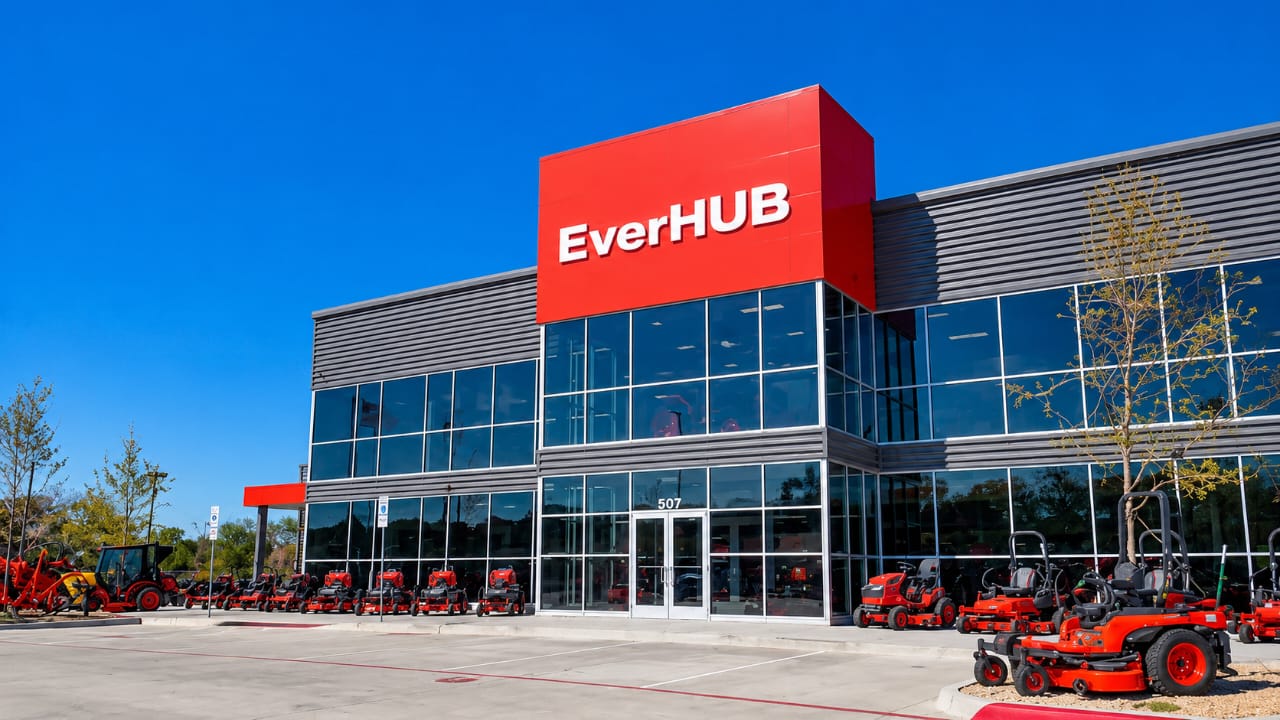
Established in 2010, Everhub is a lawn equipment business built around a simple idea: the machine you choose should make sense for the work you need it to do.
Our range brings together different approaches to lawn maintenance, including robotic, zero-turn, riding and remote-controlled mowers. These are not simply different versions of the same machine. Each category is built around a different combination of mechanical design, power delivery, cutting technology, control and, in the case of autonomous equipment, increasingly sophisticated electronic systems.
That difference is what interests us at Everhub. A lawn mower may appear simple from the outside, but underneath the deck is a combination of engineering decisions that determine how it cuts, moves, turns, handles terrain, uses energy and interacts with the person operating it—or, increasingly, whether it can operate without one.
Lawn equipment has never been a one-machine-fits-all industry. A compact residential lawn, a large open property and difficult terrain place very different demands on a mower.
That is why we don't look at mower categories simply as products sitting beside one another in a catalogue. A zero-turn mower is engineered around maneuverability and rapid directional changes. A riding mower prioritizes operator-controlled coverage and versatility. A remote mower separates the operator from the machine, while a robotic mower introduces autonomous control into the mowing process.
Our purpose is to bring these different approaches together so customers can explore equipment according to how they actually intend to work.
The lawn equipment market offers more choices than ever, but more choice can also make purchasing more complicated. Different mower types are designed for different applications, and specifications that look impressive on paper may not necessarily make one machine suitable for every property.
Everhub exists to simplify that process. We bring products, useful information and customer support together so you can understand your options before deciding what to buy. Our goal isn't to tell every customer that the same mower is right for them. It's to help you find equipment that makes sense for your property and requirements.
When you're ready to compare different machines, our Comparison Guide provides another way to evaluate your options before making a purchase.
Everhub operates as a lawn equipment Wholesale and inventory business, rather than a mower manufacturer. Our machines are sourced from established manufacturing and supply partners in China, one of the world's major production centres for lawn and outdoor power equipment. Chinese manufacturers currently produce a broad range of mower technologies, including robotic, riding, zero-turn and remote-controlled equipment, with many manufacturers supplying international markets through OEM, ODM and direct export channels.
Our approach is to work through established supply channels to obtain current production models and original manufacturer-supplied equipment, rather than presenting Everhub as the company that designed or manufactured the machines. Product availability, production versions and specifications can change as manufacturers update their equipment, so our sourcing process is focused on obtaining the appropriate current model and keeping the product information associated with that inventory accurate.
From Factory Supply to Customer Delivery
Once equipment is sourced, the process doesn't end at the factory. Machines have to move through international freight, documentation, customs and final fulfilment before reaching the customer. Everhub's role is to coordinate the commercial side of that process and make the equipment available through our inventory and ordering system.
For customers who want to understand what happens between supplier → inventory → order → delivery, we've separated the detailed fulfilment information from our About page so it is easy to reference.
[View Our Logistics & Delivery Process →]
The engineering story of the lawn mower goes back much further than today's gasoline engines, batteries and autonomous systems.
In 1830, English inventor Edwin Beard Budding patented a mechanical lawn mower after recognizing that a rotating cutting mechanism used in machinery for finishing woollen cloth could be adapted to cut grass. His design used a wheeled frame and rotating cylinder, creating a mechanical alternative to the scythe for maintaining grass. The Science Museum Group identifies Budding's patent as an early foundation of the modern lawn mower.
What is interesting about Budding's machine is that many of the fundamental engineering questions still exist today: How should the cutting mechanism interact with the grass? How should motion be transferred into cutting action? How should cutting height be controlled? How should the machine move efficiently across the ground?
The technology has changed enormously, but those basic engineering problems remain at the heart of mower design.
Explore the Science Museum Group's historical lawn-mower collection → Science Museum Group – Lawn Mower Collection
Early lawn mowers depended heavily on the operator or another source of mechanical force. The introduction of powered systems changed the scale and speed at which grass could be maintained.
Internal-combustion engines eventually became a major part of lawn-equipment development, allowing manufacturers to build machines capable of handling larger cutting loads and covering greater areas without relying entirely on human effort.
This created another engineering layer: the mower was no longer only a cutting machine. It became a powertrain. The engine produced power, the drivetrain transferred it, the cutting system converted it into grass-cutting action, and the chassis had to carry and stabilize the entire system.
That basic architecture eventually led to increasingly specialized machines—including riding mowers and zero-turn designs—where power, traction, steering and cutting capacity became integrated into a much larger mechanical platform.
A modern mower is a collection of systems working together.
The cutting system determines how grass is severed. Traditional reel or cylinder mowers use a rotating cylinder working against a fixed blade, while rotary systems use rapidly rotating blades beneath a deck. The choice affects cutting behavior, maintenance and the type of lawn for which the machine is appropriate.
The power system supplies the energy required to move the machine and operate the cutting mechanism. Depending on the mower, that may come from an internal-combustion engine, electric motor or battery system. How that energy is generated, stored and delivered has a direct relationship with the machine's operating characteristics.
Then there is the drivetrain, chassis, deck, steering and traction system. These components determine how the mower transfers power to the ground, carries its cutting equipment and responds to the operator. On larger machines, these systems become increasingly important because the mower is not simply cutting grass—it is moving a substantial machine across varied terrain while maintaining a controlled cutting height.
Understanding these relationships is important to how we look at lawn equipment at Everhub.
Zero-turn mowers demonstrate how changing one part of a machine's architecture can completely change its behavior.
Rather than relying on conventional steering geometry, many zero-turn designs use independently controlled drive wheels. By varying the speed and direction of the drive wheels on either side, the machine can make very tight turns and, in many configurations, rotate around its own footprint.
This design is particularly useful where mowing involves frequent turns around obstacles, landscaping features or irregular sections of property. The advantage isn't simply that the machine can turn tightly; the underlying drive architecture allows the operator to change direction rapidly while maintaining control over the cutting deck.
That is why zero-turn equipment is better understood as a maneuverability-focused mowing platform, rather than simply a larger riding mower.
Explore Zero-Turn Mowers →
Riding mowers take another approach. Instead of optimizing primarily for extremely tight maneuvering, they place the operator on the machine and provide a platform designed to cover larger areas with less physical effort than a walk-behind mower.
Their engineering brings together the engine or motor, transmission or transaxle, steering mechanism, chassis, cutting deck and operator controls. The balance between these systems affects how the machine behaves under load and across different lawn conditions.
Riding mower designs can vary significantly in size and configuration, which means the category covers a broad range of applications. For some properties, the priority may be versatility and ease of operation; for others, it may be cutting width, power or the ability to cover larger areas efficiently.
Explore Riding Mowers →
Remote-controlled mowing introduces a different engineering problem: how do you control a machine effectively when the operator is not sitting on it?
A remote mower typically combines propulsion, steering and cutting systems with electronic control and a communication link between the operator and machine. Instead of physical controls being directly connected to the machine's movement, commands are transmitted electronically.
This architecture can be particularly interesting for demanding mowing environments where keeping the operator away from the machine can provide an operational advantage. Terrain, visibility, vegetation and accessibility can all influence where remote operation makes sense.
The important point is that remote mowing is not simply "a mower with a remote." It represents the integration of machine control, propulsion and communication systems into a single operating platform.
Explore Remote Mowers →
Explore Robotic Mowers →
Robotic mowing represents one of the most significant changes in the history of lawn equipment because it changes the role of the operator entirely.
Husqvarna introduced what it describes as the world's first commercial robotic lawn mower in 1995, with its solar-powered Solar Mower. The company had begun exploring robotic mowing several years earlier, and the first generation of Automower followed as the technology developed.
The engineering challenge was no longer simply to make a mower cut grass. The machine also had to determine where it was, where it could travel, when it should mow and when it should return to charge.
That introduced electronics, sensors, control logic and navigation into a machine that had historically depended on a person for almost every movement.
Early robotic mowing relied on relatively simple approaches to keeping the machine within its working area. Modern systems can incorporate much more sophisticated positioning and sensing technologies.
Depending on the design, today's robotic mowers may use combinations of boundary systems, satellite positioning, GNSS, RTK correction, cameras, sensors, mapping and obstacle-detection technology.
RTK, for example, can improve positioning accuracy by using correction information from a reference source. That can allow appropriately equipped robotic systems to understand their position with considerably greater precision than basic satellite positioning alone.
The significance isn't the acronym itself. It is what the technology allows the machine to accomplish: more controlled navigation, more predictable coverage and, in suitable systems, operation without the traditional physical boundary wire.
This is where lawn equipment begins to overlap with robotics, software, electronics and positioning engineering.
Although mower categories differ considerably, we find it useful to think about modern equipment through four fundamental systems.
Cutting — How does the machine physically remove grass?
Power — Where does the energy come from, and how is it delivered?
Movement — How does the machine transfer power into controlled motion across the ground?
Control — How does the operator—or the machine itself—determine where and how it moves?
Traditional equipment places most of the control responsibility with the operator. Remote mowers move some of that control away from the machine. Robotic mowers take the concept further by combining sensing, positioning and software with the mechanical systems required to actually mow.
That evolution is one of the reasons modern lawn equipment is such an interesting engineering field.
At Everhub, we don't consider a machine's technical complexity an advantage by itself.
A mower can have sophisticated electronics and still be inappropriate for a particular lawn. A powerful engine can be unnecessary for a smaller property. A wide cutting deck can become a disadvantage where maneuverability is more important. A highly automated robotic system may provide little benefit if the property does not suit its operating requirements.
Good equipment is therefore not about having the most impressive specification sheet. It is about matching engineering to application.
That principle influences how we organize our products and how we approach the equipment we offer.
The lawn mower of the future is unlikely to be defined by mechanical engineering alone.
Modern equipment increasingly combines traditional systems—motors, engines, transmissions, cutting decks, wheels and chassis—with electronics, sensors, software, connectivity and positioning technology.
Robotic mowing demonstrates this transition particularly clearly. A machine still needs the mechanical ability to cut grass and move across the ground, but it can now also incorporate systems that help it perceive its surroundings, determine its position and make decisions about its movement.
This doesn't make mechanical engineering less important. It makes the interaction between mechanical and digital systems more important.
That is the direction we continue to watch closely at Everhub
Everhub was established in 2010, at a time when lawn equipment was already moving beyond the traditional engine-and-blade model.
Since then, autonomous mowing, battery-powered equipment, advanced positioning and remote-operated machinery have continued to expand the possibilities of what a lawn mower can be. At the same time, conventional riding and zero-turn machines remain highly relevant because the fundamental requirements of larger properties—power, coverage, traction and operator control have not disappeared.
Our role is to operate within this changing landscape while maintaining a clear focus on the equipment itself.
We want Everhub to be a place where customers can discover machines, understand the engineering behind them and purchase equipment suited to the work they need to accomplish.
We believe a lawn equipment business should understand more than the name and price of the machines in its catalogue.
It should understand why different mower architectures exist, what engineering problems they are designed to solve and how their systems affect the way the machine operates.
That is the standard we want Everhub to build around.
We're not interested in making every machine sound identical or claiming that one category is universally better than another. A robotic mower, zero-turn mower, riding mower and remote mower exist for different reasons. Understanding those reasons is where better equipment decisions begin.
Whether you're researching autonomous mowing, looking for a high-maneuverability zero-turn machine, comparing riding equipment or exploring remote-controlled mowing, Everhub gives you a place to start.
Read the Buying Guide →
Contact Everhub →
Built with Mobirise
Free Web Page Creator