Riding Lawn Mowers : How to Choose, Use & Buy the Right Mower (2026 Guide)

Riding lawn mowers make it possible to maintain larger areas of turf with less physical effort than a walk-behind mower. But “riding mower” covers several different machines, from compact rear-engine riders and lawn tractors to garden tractors and zero-turn mowers.

The right machine depends on more than acreage. Deck width, terrain, turning radius, transmission, power source, mowing speed, attachments and storage access can all change which mower makes the most sense.

Browse our riding lawn mowers to compare available machines, or continue below to understand which type fits your property.

Mobirise Website Builder

What Is a Riding Lawn Mower?

A riding lawn mower is a powered mower that allows the operator to sit on the machine while controlling its movement and cutting system.

The basic mechanical system contains:

. Engine or electric motor
. Transmission
. Drive wheels
. Steering or independent drive controls
. Cutting deck
. Blades
. Operator controls
. Fuel system or battery system
. Safety interlocks

The engine or motor supplies rotational power. The transmission converts that power into controlled wheel movement, while a separate drive system turns the cutting blades.

This separation is important.

Moving the mower and cutting the grass are two different mechanical jobs.

On a traditional lawn tractor, the steering wheel controls the front wheels while the transmission drives the tractor. On a zero-turn mower, independent wheel drives allow the operator to vary the speed of each side, producing much tighter turns.

Different Types of Riding Lawn Mowers

Lawn Tractors

Lawn tractors are the general-purpose choice for many homeowners.

They typically use:

. Steering-wheel control
. Front-mounted engine
. Mid-mounted cutting deck
. Hydrostatic or other transmission systems
. Optional collection and utility attachments

They are particularly useful when mowing is not the only job the machine will perform.

Some configurations can support baggers, trailers, spreaders and other lawn-care equipment.

Garden Tractors

A garden tractor is generally built around a heavier-duty platform than a basic lawn tractor.

The distinction is less about a single horsepower number and more about the machine's:

Chassis
Transmission
Attachment capability
Construction
Intended workload

If mowing is only one part of your property-maintenance work, a garden tractor can make more sense than buying a machine optimized only for cutting grass.

 Small Riding Lawn Mowers

Small riding lawn mowers can be useful when storage space, gate width or maneuverability is more important than maximum mowing capacity.

A smaller deck can be advantageous around:

Trees
Landscaping beds
Fences
Narrow passages
Smaller lawns

The tradeoff is simple:

Smaller deck = fewer clearance problems, but more mowing passes.

Zero-Turn Riding Mowers

Zero-turn riding mowers use independent wheel-drive systems rather than conventional front-wheel steering.

By changing the speed and direction of the drive wheels independently, the machine can make extremely tight turns.

This makes ZTRs particularly effective for lawns with:

Trees
Beds
Buildings
Fences
Numerous obstacles
Large open areas where mowing productivity matters

Electric Riding Mowers

Electric riding mowers replace the internal-combustion engine with electric motors powered by rechargeable batteries.

Their main advantages include:

. Lower operating noise
. No gasoline storage
. Instant electric motor response
. Reduced routine engine maintenance
. No tailpipe emissions during operation

The main consideration is energy capacity.

A battery-powered mower has a finite amount of stored energy, so the useful question isn't simply:

“How powerful is the battery?”

It's:

Can the battery supply enough energy to complete the required mowing work under the actual conditions?

Current battery riding-mower models have become increasingly capable, but battery capacity, deck size, terrain and mowing conditions still determine practical runtime.

RIDING MOWER CATEGORY
How to Start a Riding Lawn Mower

The exact starting procedure varies by model.

A typical sequence is:

. Sit in the operator position.
. Engage the parking brake.
. Disengage the mower blades/PTO.
. Place the transmission/control in the manufacturer's required starting position.
. Insert the key or activate the start control.
. Start the engine according to the operator's manual.
. Allow the machine to stabilize before engaging the cutting system.

Never bypass a mower's safety interlocks.

For a specific machine, the operator's manual takes priority over a generic starting procedure.

How to Operate a Riding Lawn Mower

Operating a riding mower correctly is more than steering and lowering the deck.

Before mowing

Inspect:

. Tires
. Blades
. Deck
. Fuel or battery
. Engine oil where applicable
. Safety controls
. Mowing area

While mowing

Maintain:

. Appropriate cutting height
. Controlled ground speed
. Consistent passes
. Safe distance from obstacles
. Appropriate slope direction

When turning

Avoid unnecessarily sharp turns that can damage turf, particularly on soft ground.

On slopes

Follow the manufacturer's slope limitations and operating instructions.

Terrain can be more important than acreage when selecting a mower.

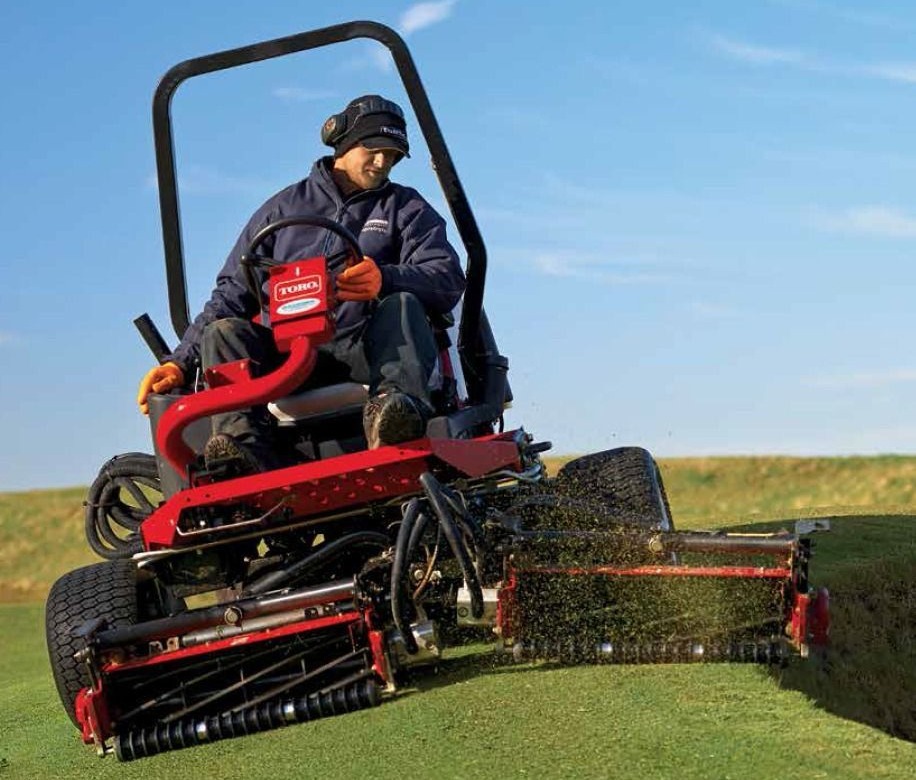
Commercial Toro steering-wheel zero turn Riding reel mower trimming golf course turf edge

Mobirise Website Builder

How Do You Choose the Right Deck Width?

A wider deck reduces the number of passes needed across an open lawn.

But bigger isn't automatically better.

Wider deck

Advantages


. More grass per pass
. Potentially faster mowing
. Useful on open properties

Disadvantages

. Larger machine
. Less convenient in narrow spaces
. More difficult around dense landscaping
. May require larger storage space

Smaller deck

Advantages


Easier maneuverability
Better access through narrow areas
Useful for smaller or complex lawns

Disadvantage

More passes required

Retailer guidance similarly connects deck width with lawn size while noting that smaller decks can be preferable where obstacles limit maneuverability.

What Is the Best Lawn Mower to Buy?

The best lawn mower to buy is the one that matches your property and how you intend to use it. For a typical medium-to-large residential lawn, a lawn tractor is often the most versatile choice. For large, open lawns where mowing speed and maneuverability are priorities, a zero-turn mower can be the better option. If you need a machine for multiple attachments and heavier property work, a garden tractor may make more sense.

There is no advantage to buying a larger mower simply because it has more horsepower or a wider deck.

The machine has to fit the property

What Is the Best Lawn Tractor?

A good lawn tractor should balance:

. Deck size
. Engine/motor capability
. Transmission
. Maneuverability
. Operator comfort
. Serviceability
. Attachment compatibility

For most homeowners, hydrostatic transmission is one of the most useful upgrades because it allows smooth speed control without manually shifting gears.

Current manufacturer buying guidance distinguishes manual, automatic and hydrostatic systems, with hydrostatic drive providing continuously controlled forward and reverse speeds.

The best lawn tractor isn't necessarily the largest one.

It is the tractor that gives you enough cutting capacity without becoming unnecessarily difficult to maneuver or store.

How Wide Is a Riding Lawn Mower?

Residential riding mower cutting decks commonly range from roughly 30 to 54 inches, with larger machines available. The mower's overall physical width can be greater than its cutting width, so measure the complete machine when checking gates, storage doors and trailers.

This distinction is important.

Cutting width

The width of grass removed during a mowing pass.

Overall mower width

The actual space occupied by the machine.

A 48-inch deck does not mean the entire mower is exactly 48 inches wide.

Before purchasing, measure:

Gate opening + storage entrance + trailer width + tightest passage

Then compare those dimensions with the manufacturer's machine specifications.

How Fast Do Riding Lawn Mowers Go?

Many residential riding lawn mowers mow at roughly 4–6 mph, although maximum speeds vary by model. Some zero-turn and commercial machines are considerably faster.

But top speed should not be the deciding specification.

Actual mowing productivity depends on:

Deck width × ground speed × turning efficiency × terrain × overlap


A mower traveling at 7 mph doesn't necessarily finish a property faster if its deck is narrow or the operator spends more time maneuvering around obstacles.

This is why field productivity matters more than advertised top speed.

Engine Power, Horsepower and Torque

Horsepower is useful, but it shouldn't be the only number you compare.

Horsepower

Represents the rate at which an engine can produce mechanical power.

Torque

Represents rotational force.

Why that matters

Cutting thick, wet or tall grass places more load on the cutting system.

The engine must maintain sufficient blade speed while dealing with that load.

A mower with adequate power for normal lawn conditions may behave differently when:

Grass is wet
Grass has become overgrown
The deck is heavily loaded
The terrain is demanding

The goal isn't maximum horsepower. The goal is adequate power for the workload.

Riding Lawn Mower Transmission Explained

Three common approaches are:

Manual transmission

Uses selectable gears and generally requires clutch operation.

Automatic transmission

Allows easier speed changes than a traditional manual system.

Hydrostatic transmission

Uses hydraulic power transmission to provide smooth variable-speed control.

For homeowners who frequently slow down, accelerate or reverse around landscaping, hydrostatic drive can be particularly convenient.

Riding Lawn Mower Battery: What Buyers Need to Know

The battery serves a different role depending on the mower.

On a gas riding mower, a small starting battery supplies electrical power for starting and onboard systems.

On an electric riding mower, the battery is the primary energy source for propulsion and cutting. That distinction matters.

For an electric riding mower, compare:

Battery voltage
Battery capacity
Number of batteries
Recharge time
Mowing area per charge
Charger requirements
Battery replacement cost
Whether batteries are removable

Don't compare voltage alone.

A higher voltage system doesn't automatically mean longer runtime because total stored energy also depends on battery capacity.

What Is the Best Riding Lawn Mower?

There is no single best riding lawn mower for every property. The best choice depends on lawn size, terrain, obstacles, desired mowing speed, deck width, transmission, power source and whether you need attachments.

How to Cut Grass on a Riding Mower

Set the correct cutting height, mow at an appropriate ground speed, keep the blades sharp, overlap passes slightly and avoid mowing when the grass is excessively wet.

A good mowing pattern should distribute traffic and avoid repeatedly forcing the machine over the same turf path.

If grass is tall

Don't automatically drive faster.

The cutting system has to process the grass being fed into the deck.

Reducing ground speed can give the blades more opportunity to process heavy grass.

If the deck leaves clumps

Check:

Grass moisture
Grass height
Blade condition
Ground speed
Deck cleanliness
Deck leveling

Best Grass Cutting Riding Mower: What Actually Makes One Good?

A good grass-cutting mower isn't defined by one specification.

Look for:

. Properly sized deck
. Good blade condition
. Consistent blade speed
. Level deck
. Appropriate ground speed
. Adequate power
. Good discharge design
. Suitable tire pressure
. Maneuverability appropriate to the lawn

The cutting deck is the heart of the machine.

It houses the blades and controls the airflow that lifts, cuts and distributes the grass.

A wider deck can improve productivity, but only if the mower can maintain cutting performance under the conditions you're giving it.

Riding Lawn Mower With Bagger: When Do You Need One?

A bagger is useful when you want to collect:

. Grass clippings
. Leaves
. Lawn debris

It's particularly useful where clippings must be removed rather than left on the lawn.

But collection comes with a tradeoff:

You have to stop and empty the system.

A bagger also adds weight and changes the machine's rear profile.

If your normal mowing strategy is mulching or side discharge, a bagger may not be necessary.

Mobirise Website Builder

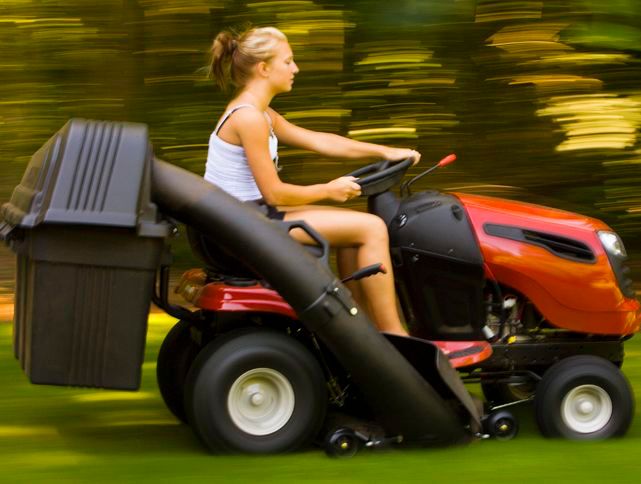
Conventional riding lawn tractor with rear bagger attachment mowing grass on flat lawn

Are Riding Lawn Mowers Better Than Walk-Behind Mowers?

A riding mower makes sense when the area, mowing frequency or physical workload makes walking behind a mower inefficient.

The tradeoff is ownership complexity.

A riding mower introduces:

. Engine/motor
. Transmission
. Drive system
. Battery
. Belts
. Larger deck
. More tires
. More mechanical components

So the question isn't:

“Is a riding mower better?”

It's:

Does the property justify the additional machine?

That's the better buying question.

Different Riding Lawn Mower Brands

The most popular and Best known lawn mower brands include:

. Husqvarna
. John Deere
. Toro
. Cub Cadet
. EGO

Riding John Deere Mowers

John Deere offers both traditional lawn tractors and zero-turn equipment.

 compare the specific model's deck, transmission, power source, dimensions and intended application rather than assuming the brand alone determines performance.

How to Change Riding Lawn Mower Blades

Before touching the blades

. Park on level ground.
. Turn the mower off.
. Remove the ignition key.
. Disengage the PTO/cutting system.
. Follow the model-specific safety procedure.
. Disconnect the spark plug lead on applicable gas machines.
. Follow the manufacturer's instructions for electric models.
. Wear appropriate protective gloves.
. Prevent the blade from rotating before loosening hardware.

Manufacturer instructions vary by mower.

Husqvarna specifically advises using manufacturer-approved blades and following the specified torque for the blade fastener.

A typical procedure involves placing the deck in the appropriate service position, securing the blade against rotation, removing the blade fastener, installing the correct replacement blade in the correct orientation and tightening the fastener to the model-specific specification.

Do not use a generic torque value for every riding mower.

The correct value belongs in the operator's manual.

Troy-Bilt likewise emphasizes disconnecting the ignition system, engaging the parking brake and following model-specific procedures when replacing blades.

Riding Lawn Mower Maintenance

A basic maintenance schedule should include:

Every use

. Check blades
. Inspect deck
. Check for debris
. Check tires
. Inspect obvious leaks/damage

Periodically

. Engine oil
. Air filter
. Spark plugs
. Belts
. Battery
. Tire pressure
. Grease points
. Blade condition

Annually or according to the manual

Complete the manufacturer's scheduled service.

Husqvarna's service guidance, for example, includes inspection/service of oil, filters, spark plugs, grease fittings, tire pressure, belts, pulleys and blades depending on mower type.

Where to Buy a Riding Lawn Mower

This should be one of your strongest commercial sections.

The best place to buy a riding lawn mower is a retailer or authorized dealer that can provide the machine, replacement parts, warranty support and service appropriate to your needs.

For a straightforward residential purchase, availability and price may be the biggest considerations.

For a more expensive tractor or commercial mower, local technical support can become much more important.

Before purchasing, check:

. Current price
. Availability
. Delivery
. Setup/assembly
. Warranty
. Parts
. Service
. Attachments
. Financing, if available

Browse our riding lawn mowers for sale to compare models by mower type, deck size, power source and intended application.

Company
  • About
  • Press
  • Careers
  • Social
  • Contact
Features
  • Branding
  • Promotion
  • Design
  • Creative
  • Production
Support
  • Help
  • Info
  • Contacts
  • FAQ
  • Report
About
  • History
  • Clients
  • Teams
  • Brand
  • Terms
 Free Web Page  Creation Software

Created with Mobirise ‌

Website Designer Software