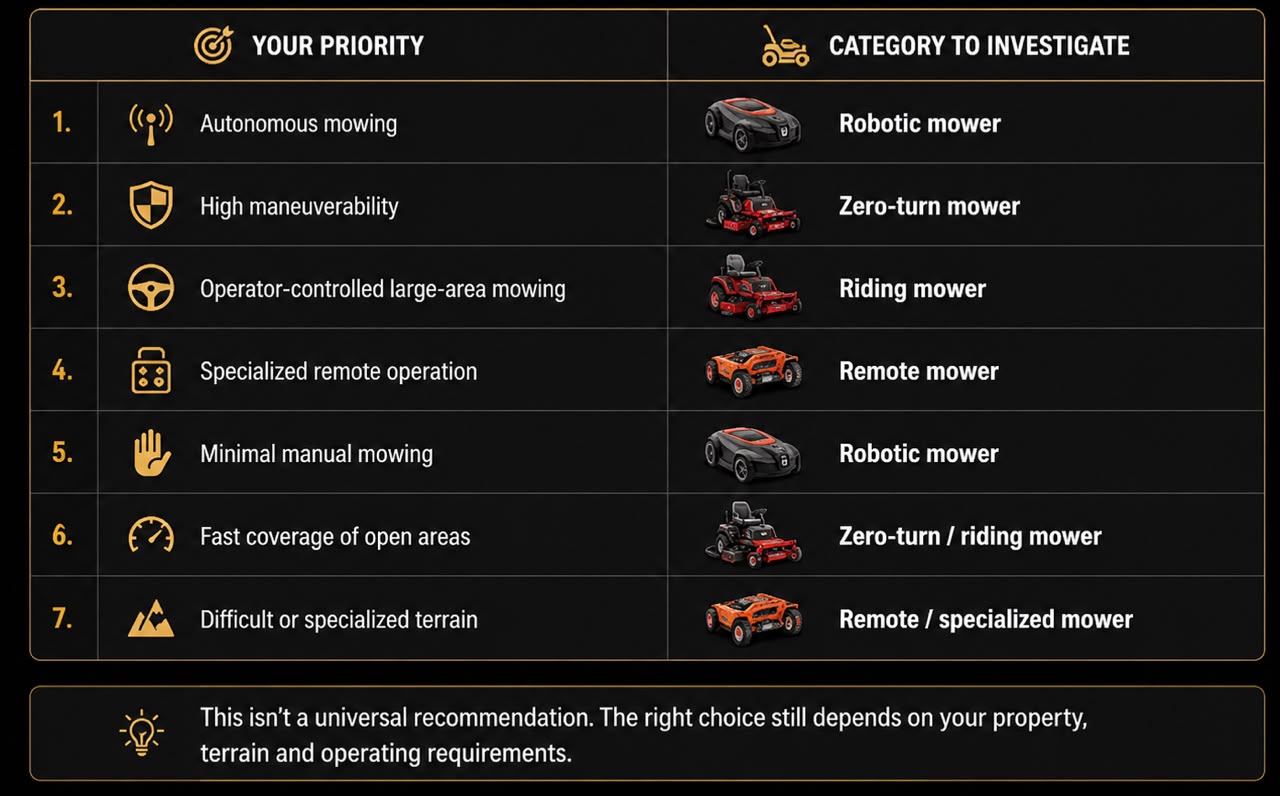
The best lawn mower isn't necessarily the biggest, fastest or most technologically advanced machine. It is the one that matches the size, terrain, layout and condition of your property while giving you the level of control, productivity and maintenance you actually need.
With modern lawn equipment ranging from robotic and battery-powered machines to riding, zero-turn and remote-controlled mowers, choosing the right equipment can quickly become confusing. Specifications can tell you what a machine has, but they don't always tell you whether those specifications make sense for your lawn.
This guide takes you through the important decisions before you buy-from mower types and cutting systems to power, traction, navigation, maintenance, operating costs and the specifications worth paying attention to..
Before looking at brands or specifications, understand the environment the machine will have to work in.
Consider:
. Total lawn area
. Terrain and slope
. Grass type and density
. Number of obstacles
. Narrow passages and access points
. Mowing frequency
. Desired mowing time
. Operator involvement
. Storage and maintenance requirements
A large, open lawn may benefit from a wide cutting deck and high productivity. A smaller property with numerous trees, landscaping features and tight spaces may place greater value on maneuverability.
Likewise, a sloped property can make traction, stability and terrain capability more important than simply choosing a machine with greater engine power.
Before buying, ask yourself:
How much grass do I need to maintain?
How difficult is the terrain?
How often will the machine operate?
Do I want to operate the mower myself or automate the work?
These answers narrow your choices considerably.
Robotic Lawn Mowers
Robotic mowers are designed to automate routine lawn maintenance. Depending on the model, they can use boundary systems, GNSS/RTK positioning, cameras, sensors and mapping technology to navigate the mowing area.
They are particularly suited to buyers who want regular autonomous mowing with less manual involvement.
Different Mowers Solve Different Problems
Zero-turn mowers use independent control of the drive wheels to provide exceptional maneuverability. The operator can make very tight turns around trees, landscaping and other obstacles.
They are particularly useful when productivity and maneuverability are important across larger areas.
Best
Large lawns, estates, commercial properties and users who want high mowing productivity.
Consider:
Deck width, engine output, transmission, terrain, fuel capacity and operator comfort.
Riding Lawn Mowers
Riding mowers allow the operator to sit on the machine while controlling the mowing operation. They offer a practical middle ground between walk-behind equipment and larger professional machines.
Best for:
Medium-to-large properties where riding comfort and efficient coverage are important.
Consider:
Cutting width, engine power, transmission, fuel capacity, turning radius and terrain.
Explore Riding Mowers →
Remote-Controlled Mowers
Remote mowers allow the operator to control the machine from a distance. This can be particularly useful where direct operation is inconvenient or where specialized terrain and vegetation require additional separation between operator and machine.
Best for:
Specialized mowing applications, challenging terrain and situations where remote operation provides a practical advantage.
Consider:
Control range, slope capability, traction, cutting system, machine weight and safety systems.
Explore Remote Mowers →
Match Capacity to the Area You Need to Maintain
Lawn size is one of the first specifications to consider, but acreage should not be viewed in isolation.
A mower's real productivity depends on the relationship between:
Cutting width + travel speed + maneuverability + terrain + obstacles + mowing frequency
Small lawns
Compact dimensions, maneuverability, easy storage and simple operation may be more valuable than maximum cutting capacity.
Medium lawns
A balance between cutting width, operating efficiency, maneuverability and ownership cost becomes more important.
Large lawns
Higher cutting capacity, power, fuel or battery capacity, operator comfort and terrain capability can become major considerations.
Large but complex properties
Acreage alone can be misleading. A large property filled with trees, landscaping and narrow areas may benefit from a highly maneuverable mower rather than simply the widest machine available.
The objective isn't to buy the largest mower you can afford. It's to buy enough capability for the work you actually perform.
4. Understand Cutting Width
Does a Wider Deck Mean a Better Mower?
Cutting width determines how much grass is covered during each pass.
A wider deck can reduce the number of passes required across an open lawn, potentially increasing mowing productivity.
But there is a trade-off.
A wider mower can be harder to maneuver through narrow spaces and around closely spaced obstacles.
Consider:
Open property → wider deck can be advantageous
Complex property → maneuverability may matter more
This is why cutting width should always be considered alongside your lawn's layout.
5. Understand Cutting Height
How Short Should Your Grass Be?
Cutting height determines how much grass remains after mowing.
The correct setting depends on the grass species, season, lawn condition and mowing practices.
Rather than assuming that the lowest cutting setting produces the best-looking lawn, buyers should consider the manufacturer's adjustment range and choose a setting appropriate for their grass and growing conditions.
When comparing machines, check:
. Minimum cutting height
. Maximum cutting height
. Adjustment mechanism
. Number of height positions
. Whether adjustment is centralized or individual
Gasoline or Battery?
Powertrain choice affects performance, maintenance, operating costs and how you use the machine.
Gasoline-Powered Mowers
Internal-combustion engines remain common in riding and zero-turn equipment because they can provide substantial continuous power for demanding mowing applications.
Consider:
. Engine displacement
. Power output
. Fuel capacity
. Fuel consumption
. Oil requirements
. Air filtration
. Spark plugs
. Routine servicing
Battery-Electric Mowers
Battery-powered machines use electric motors instead of internal-combustion engines.
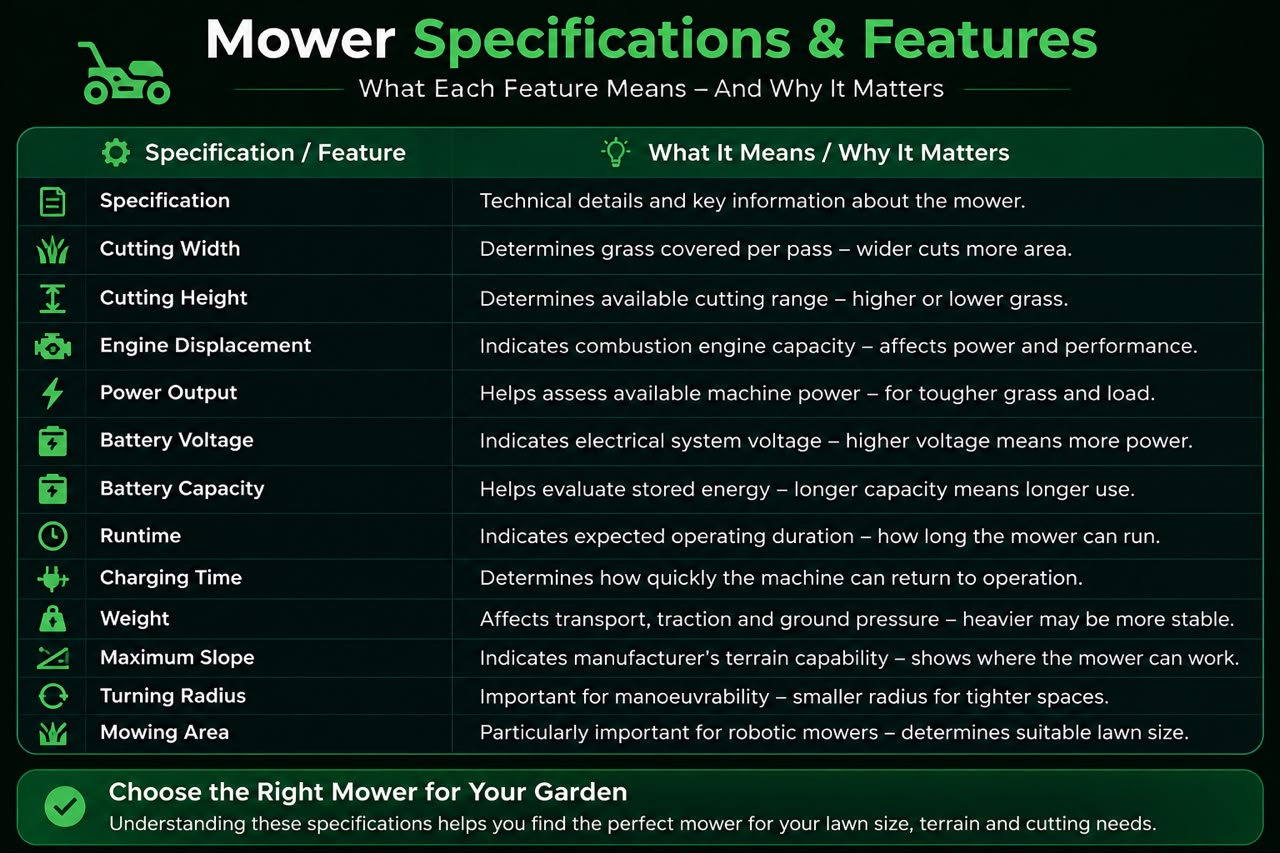
Important specifications include:
. Battery voltage
. Battery capacity
. Runtime
. Charging time
. Number of batteries
. Charging system
. Battery replacement cost
Electric drive can simplify certain maintenance requirements, but battery capacity and charging infrastructure become important parts of ownership.
The important question
Don't ask only:
"Which power system is better?"
Ask:
"Which power system fits how I mow?"
7. Understand Engine and Motor Specifications
What Do the Numbers Actually Mean?
Specifications can look impressive without necessarily being relevant to your application.
Engine displacement
Measured commonly in cubic centimetres (cc), displacement refers to the swept volume of the engine's cylinders.
Greater displacement does not automatically mean better performance, but it can be associated with greater engine capacity depending on the engine design.
Horsepower
Horsepower describes power output. It can be useful when comparing combustion-powered machines, but it should be evaluated alongside the mower's deck, transmission and overall design.
Electric motor power
Electric mower specifications may be presented differently depending on the manufacturer. Battery voltage and capacity should be considered together with motor design and actual operating requirements.
Never compare one number in isolation.
A mower is a system of components working together.
Flat Lawn or Difficult Ground?
Terrain can fundamentally change the type of mower you need.
Before purchasing, determine:
. Maximum slope
. Surface condition
. Traction requirements
. Ground clearance
. Wheel or track configuration
. Weight distribution
. Wet or slippery conditions
For riding and zero-turn mowers, traction and stability become increasingly important on inclines.
For robotic and remote mowers, the manufacturer's specified slope capability is particularly important because the machine must maintain controlled movement without direct physical intervention.
Important:
Never assume that a heavy or powerful mower is automatically suitable for steep terrain.
Always check the manufacturer's rated operating limits for the specific model.
Why Are Zero-Turn Mowers So Maneuverable?
Zero-turn mowers achieve their characteristic maneuverability through independent control of the left and right drive wheels.
When the two sides operate at different speeds, the mower turns. When the drive wheels rotate in opposite directions, the machine can pivot around a very small turning radius.
This allows operators to mow efficiently around:
. Trees
. Flower beds
. Buildings
. Fences
. Landscaping
Other obstacles
But maneuverability isn't the only consideration.
Also evaluate:
. Deck width
. Engine output
. Transmission
. Fuel capacity
. Operator comfort
. Terrain
. Maintenance access
Explore Zero-Turn Mowers →
What Makes a Mower Autonomous?
A robotic mower has to do more than cut grass.
It must determine where it can operate, navigate the mowing area, manage obstacles, conserve battery power and return for charging when necessary.
Different robotic systems use different combinations of technologies.
Boundary Wire
Traditional systems may use perimeter wire to define the mowing area.
GNSS
Global Navigation Satellite Systems allow compatible machines to determine their position using satellite signals.
RTK
Real-Time Kinematic positioning uses correction information to improve satellite positioning accuracy.
For robotic mowing, this can support more precise navigation and mapping.
Cameras and Sensors
Depending on the model, cameras and sensors can help detect obstacles, identify boundaries or interpret the environment.
Mapping
Some systems create digital maps of the property, allowing different mowing zones or operating areas to be managed.
Automatic Charging
When battery power becomes low, compatible robotic mowers can return to their charging station and resume operation according to their programmed schedule.
Explore Robotic Mowers →
More Technology Isn't Always Better
Modern robotic mowers can include impressive technology, but every feature should have a purpose.
Ask:
Do I need boundary-free navigation?
Would RTK positioning benefit my property?
Do I need multiple mowing zones?
Would obstacle detection be useful?
Do I want app-based control?
Will automatic scheduling actually save me time?
A technologically advanced mower can be valuable when its technology solves a real problem.
But paying for capabilities you won't use does not necessarily make the machine a better purchase.
How Long Can a Battery Mower Work?
For battery-powered and robotic mowers, runtime is an important specification—but it should be interpreted carefully.
Actual operating time can be influenced by:
. Grass height
. Grass density
. Terrain
. Cutting height
. Operating speed
. Temperature
. Battery condition
. Mowing frequency
For robotic mowers, the overall daily mowing capacity can also depend on how efficiently the machine alternates between mowing and charging.
When comparing models, look beyond the advertised runtime.
Consider:
Battery capacity + charging time + mowing area + charging strategy
What Will Owning the Mower Actually Involve?
A mower should be evaluated not only by how it performs on day one, but by what it requires throughout its operating life.
. Gasoline machines may require:
. Engine oil
. Air-filter servicing
. Spark plugs
. Fuel-system maintenance
. Belts
. Blades
. Bearings
. Engine servicing
. Battery machines may require:
. Blade replacement
. Battery care
. Charging-system maintenance
. Sensor cleaning
. Wheel cleaning
. Electrical-system inspection
. Riding and zero-turn machines may additionally involve:
. Deck belts
. Spindles
. Transmissions or transaxles
. Tires
. Hydraulic components where applicable
Before purchasing, consider whether the machine's maintenance requirements fit your willingness and ability to maintain equipment.
The Purchase Price Isn't the Whole Cost
A cheaper mower isn't necessarily cheaper to own.
Consider:
. Purchase price
. Fuel or electricity
. Routine maintenance
. Blades and consumables
. Replacement parts
. Battery replacement where applicable
. Servicing
. Expected operating life
A more expensive machine may justify its price through greater productivity, automation, durability or reduced operating requirements.
The better comparison is therefore not simply:
"Which mower costs less?"
but:
"Which mower provides the right capability for the total cost of ownership?"
Which Makes More Sense?
New and used equipment can both make sense depending on your priorities.
New equipment
Advantages can include:
. Known condition
. Current model
. Manufacturer warranty where applicable
. New components
. Lower initial maintenance uncertainty
. Used equipment
Potential advantages include:
. Lower purchase price
. Access to higher-capacity machines
. Established models with known operating characteristics
But used equipment requires additional inspection.
Check:
. Operating hours
. Maintenance history
. Engine condition
. Battery health
. Deck condition
. Belts
. Tires
. Spindles
. Hydraulic systems where applicable
. Availability of replacement parts
A lower purchase price doesn't necessarily represent better value if significant repairs are required.
Make Sure the Machine Fits the Job
Before committing to a mower, you should be able to answer:
About your property
. How large is the area?
. What is the terrain like?
. How steep are the slopes?
. How many obstacles are present?
. Are there narrow access points?
About the machine
. What is the cutting width?
. What is the cutting-height range?
. What powers the machine?
. What is its rated operating area?
. What is its slope capability?
. How does it navigate?
. How is it maintained?
About ownership
. What consumables are required?
. How often does it require maintenance?
. What does replacement battery or component availability look like?
. What is the expected operating cost?
About the purchase
. Is the machine currently available?
. What is included?
. What warranty applies?
. How will it be delivered?
. What happens if the shipment is damaged?
. Are additional delivery or import costs applicable?
If a seller cannot clearly answer important questions about an expensive machine, that should be part of your purchasing decision.

Built with Mobirise
Free Web Site Designing Software